
Knee Arthroscopy
A knee arthroscopy is a minimally invasive procedure whereby a thin tube with a camera on the end (an arthroscope) is inserted through a small incision to enable your surgeon to look inside your knee joint. Surgical instruments are passed through other small incisions to repair the joint or remove damaged tissue. Fluid (saline) will be pumped into the area around the joint to expand the area and give greater visibility. Arthroscopic surgery is commonly known as ‘keyhole’ surgery.
An arthroscopy may be the chosen procedure to treat an already diagnosed condition or injury, or it may be performed for diagnostic purposes. During a diagnostic arthroscopy your surgeon may be able to immediately treat the cause of your knee pain.
Knee arthroscopy procedures can be performed under a local or general anaesthetic and you will usually be able to return home on the day of your procedure. You will be provided with physiotherapy exercises designed to get you back to full strength as quickly as possible.
Arthroscopic surgery is less invasive than open surgery that requires larger incisions, so pain is often less and recovery faster. However you will still need a period of rest and rehabilitation, including the required time off work.
Knee Arthroscopy Procedures
Meniscal Repair – to remove or repair torn meniscal cartilage
ACL Reconstruction – to reconstruct a torn anterior cruciate ligament
Chondroplasty – to trim and remove damaged tissue from the articular cartilage
Synovial Removal – to remove inflamed synovial tissue which lines the knee joint
Misaligned Patella (Lateral Release) – to loosen ligaments to repair misalignment of the patella
Baker’s (Popliteal) cyst – to remove swollen, fluid filled lump behind the knee
Need Help?
At One Hatfield Hospital in Hertfordshire, we can book you in to see a specialist Orthopaedic Consultant for an initial consultation, usually within 48 hours.
You can use your private medical insurance or pay for your Knee Arthroscopy treatment. We offer competitive, fixed price packages as well as the ability to spread the cost of your treatment over a number of months. If you are using your health insurance, please contact your insurer first for approval and let them know you’d like to be treated at One Hatfield Hospital.
Why One Hatfield
- Modern purpose-built hospital opened in December 2017
- Fast access to diagnostics including MRI, X-ray and Ultrasound
- Private, spacious, en-suite rooms
- Specialist physiotherapy and nursing teams
- Little or no waiting time
- ‘Ultra clean air’ theatres
- Freshly prepared food
- Calm, dignified experience
Contact us and find out more
If you are based in and around Hertfordshire, St Albans, Stevenage, Watford, North London, Welwyn or Bedfordshire and would like to visit the One Hatfield Hospital please click here.
Hip and Knee Pricing Guide at One Hatfield Hospital
This is a list of guide prices for some of common Hip and Knee treatments and procedures.
| Knee | |
| Knee - Anterior Cruciate Ligament Repair (ACL) | £9,007.50 |
| Multiple Knee Arthroscopy | £5,000 |
| Knee - Replacement | £13,845 |
| Hip | |
| Hip - Replacement | £14,020 |
Orthopaedics Pricing Guide at One Hatfield Hospital
This is a list of guide prices for some of common Orthopaedics treatments and procedures.
| Treatment | Guide Price from |
|---|---|
| Hand and Wrist | |
| Carpal Tunnel Release - One Wrist | £2,350 |
| Excision of Ganglion | £2,309 |
| Shoulder | |
| Shoulder - Rotator Cuff Repair | £8,115 |
| Foot and Ankle | |
| Bunion Removal - One Foot | £6,500 |
| Knee | |
| Knee - Anterior Cruciate Ligament Repair (ACL) | £12,495 |
| Multiple Knee Arthroscopy | £5,000 |
| Knee - Replacement | £16,100 |
| Hip | |
| Hip - Replacement | £15,770 |



 One Ashford
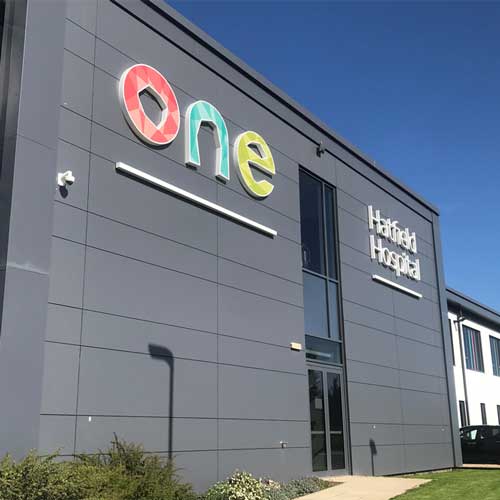 One Hatfield